
Changes to the Covid rules from 19th July

Social distancing

  • No limits on how many people can meet
  • 1m-plus guidance removed (except in some places like hospitals and passport control when entering)
  • Face coverings no longer required by law, although the government still “expects and recommends” them in crowded and enclosed spaces
  • Some shops and transport operators will still require masks

Events and gatherings

  • Nightclubs can reopen
  • Pubs and restaurants no longer table-service only
  • No limits on guests at weddings and funerals
  • No limits on people attending concerts, theatres or sports events
  • No restrictions on communal worship

Travel

  • Guidance recommending against travel to amber list countries removed
  • Under-18s and fully vaccinated adults no longer have to self-isolate after visiting amber list countries – although those returning from France to the UK must still quarantine for 10 days
  • Face coverings will continue to be required across all Transport for London (TfL) services. This includes the Tube, buses, tram, DLR, Overground and TfL Rail.
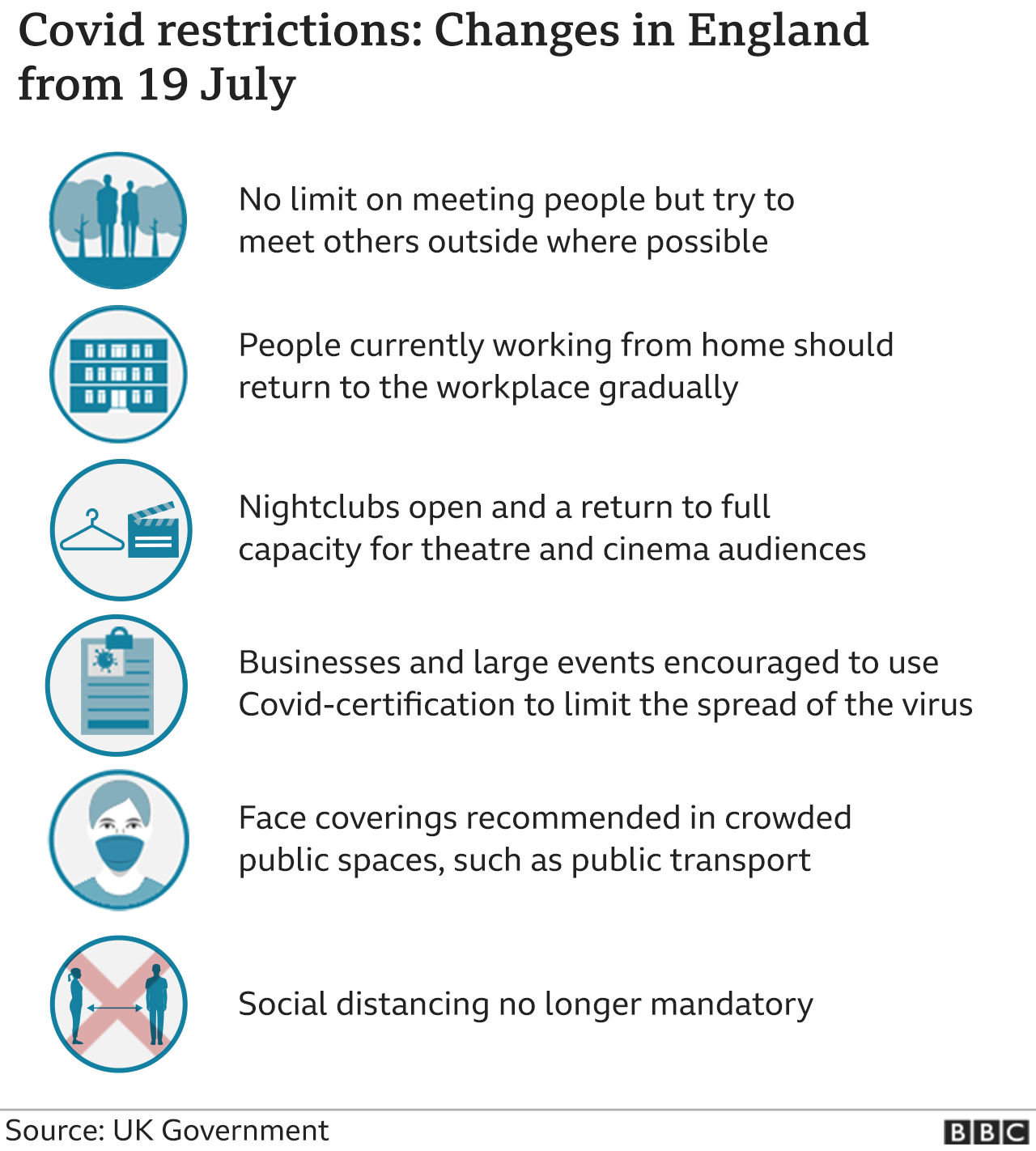
 

Graphic showing changes from 19 July

Related Posts

Community social researchers wanted

Islington Clinical Commissioning Group in partnership with the Young Foundation is looking for local people to become Community Social Researchers to help gather and generate stories and experiences of health and care in the borough. There will be free training in the...

Staff of National Charity Volunteer in Islington

Staff of National Charity Volunteer in Islington

Staff from the Islington based national organisation, NCVO, that supports charities in the UK have been volunteering with Voluntary Action Islington today. 16 staff from NCVO spent the afternoon at Voluntary Action Islington providing expert help to local community...

Our submission to Islington’s Employment Commission

Our submission to Islington's Employment Commission can be read here. In it we identify 3 main roles for the local voluntary sector in helping to tackle the barriers to employment faced by residents: 1) As a direct employer 2) As a provider of a wide range of...

Privacy Overview

This website uses cookies so that we can provide you with the best user experience possible. Cookie information is stored in your browser and performs functions such as recognising you when you return to our website and helping our team to understand which sections of the website you find most interesting and useful.

Download our Privacy and Data Protection Policy